MSP Project Revenue
The $40,000 Conversation Nobody Had: A Story About Data That Stayed Siloed

Dennis Kao
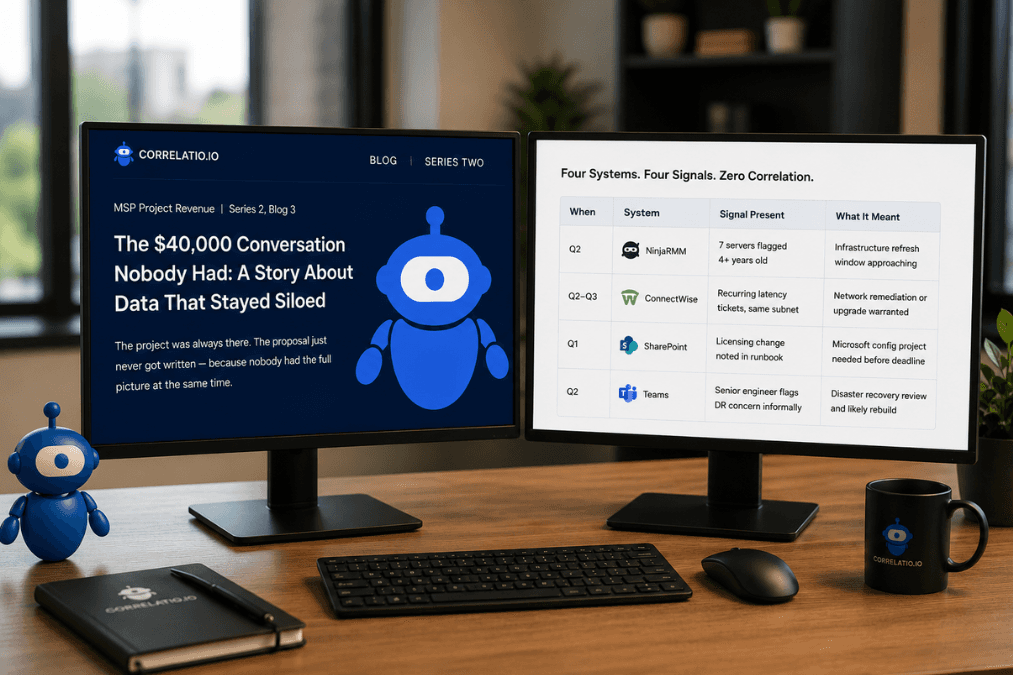
The project was always there. The proposal just never got written — because nobody had the full picture at the same time.
We’ve watched this scenario play out more times than we’d like to count. Not because the MSPs involved were careless or their teams weren’t trying, but because of how most current MSP operations are structured. The data that tells the most important story about a client’s environment never ends up in the same room at the same time.
Here is one version of how this can happen.
The scenario below is a composite drawn from a pattern we observed repeatedly while running and working alongside MSPs. The names are fictional. The situation is not. |
The Setup
Meridian Technology Group had been managing Lakewood Fabrication’s IT environment for three years. They have a solid relationship, responsive service and no major incidents. The account sat comfortably in the vCIO’s book at $4,200 MRR, renewed without drama and with cordial QBRs.
What nobody at Meridian had fully registered however, was that Lakewood’s environment had been sending signals for two consecutive quarters. Not alarms, not emergencies— just data. Sitting in the systems Meridian already had, quietly accumulating into an argument for a significant project conversation.
In NinjaRMM, seven servers flagged over four years old, three of them hosting line-of-business applications. In ConnectWise, a recurring cluster of tickets over six months all tracing back to network latency on the same subnet. In SharePoint, a runbook note from eight months prior flagging an upcoming Microsoft licensing change that would affect Lakewood’s current configuration. In Teams, a thread from Q2 where a senior engineer had mentioned offhand that ‘Lakewood’s DR setup is getting shaky’ — and the conversation had moved on.
Four systems. Four signals. Zero correlation.
When | System | Signal Present | What It Meant |
Q2 | NinjaRMM | 7 servers flagged 4+ years old | Infrastructure refresh window approaching |
Q2–Q3 | ConnectWise | Recurring latency tickets, same subnet | Network remediation or upgrade warranted |
Q1 | SharePoint | Licensing change noted in runbook | Microsoft config project needed before deadline |
Q2 | Teams | Senior engineer flags DR concern informally | Disaster recovery review and likely rebuild |
The Miss
The Q3 QBR was scheduled, then pushed. The vCIO had three other accounts due the same week and QBR prep for Lakewood, done properly, would have meant pulling asset reports from NinjaRMM, cross-referencing ticket history from ConnectWise, checking the SharePoint documentation for outstanding notes, and digging back through Teams threads for anything relevant. That’s a half-day of work on a good day.
So the QBR was abbreviated. Uptime was good. Tickets were down year over year. The client was happy. The meeting ended with a handshake and a promise to ‘circle back on any upcoming projects in Q4.’
Q4 came. No follow-up happened. The signals were still there, still accumulating, still sitting in four separate systems that nobody had time to pull together.
Lakewood wasn’t unhappy with Meridian. They just started asking questions that Meridian wasn’t positioned to answer — because the questions came from a competitor who had done the homework first. |
In January, Lakewood’s operations director mentioned to a peer at an industry lunch that they were thinking about refreshing their server infrastructure and doing something about their disaster recovery setup. That peer referred them to a different MSP who offered a complimentary infrastructure assessment.
The assessment took two weeks. It surfaced the aging servers, the network issue, the licensing gap, and the DR concern — everything that had been sitting in Meridian’s own systems for two quarters. The competing MSP proposed a comprehensive project. Lakewood signed it.
The project value: $40,000.
What It Actually Cost
Meridian didn’t lose Lakewood as a client. They lost the project. At a 35% gross margin, that’s $14,000 in gross profit that left with a competitor who simply showed up with the full picture first.
But the number that stings more is the one that never gets calculated: how many Lakewoods are in a typical MSP’s book of accounts? How many clients have signals accumulating in disconnected systems right now, waiting for someone to connect them before a competitor does?
Across a book of 30 accounts operating below optimal QBR cadence, even one missed project per year per four clients is $280,000 in annual gross profit exposure. It doesn’t show up on a P&L as a line item. It shows up as growth that never happened.
The competitor didn’t know the environment better than Meridian did. They just looked at the whole picture. That’s not a competitive advantage. That’s a data problem with a name. |
Why This Pattern Is Structural, Not Accidental
The frustrating part of this scenario — and the reason we saw it consistently enough that it shaped what we built — is that Meridian did nothing wrong by the standards of how most MSPs operate. The tools were in place. The relationship was good. The team was competent. The data was there.
The problem is structural: the systems that hold the most valuable intelligence about a client’s environment were never designed to talk to each other in a way that surfaces the story they’re collectively telling. NinjaRMM doesn’t know what’s in the Teams thread. ConnectWise doesn’t correlate ticket patterns to the licensing note in SharePoint. Nobody’s PSA is going to flag a $40,000 project opportunity from the combination of four signals that each look unremarkable on their own.
That correlation gap is what SKAIA closes. Not by replacing the tools that run the operation, but by sitting across them and doing what no individual system is designed to do: connect the signals into a single, actionable picture before the window closes.
The $40,000 conversation always existed at Lakewood. Meridian had everything they needed to have it. What they didn’t have was a way to see it.
If you want to know what your client data is showing right now that nobody has connected yet, book a 30-minute demo at Correlatio.io or reach us at Ready.ai@correlatio.io.