MSP Revenue Growth
The Missing Layer: Why MSP Growth Strategy Fails Without an Execution Bridge

Dennis Kao
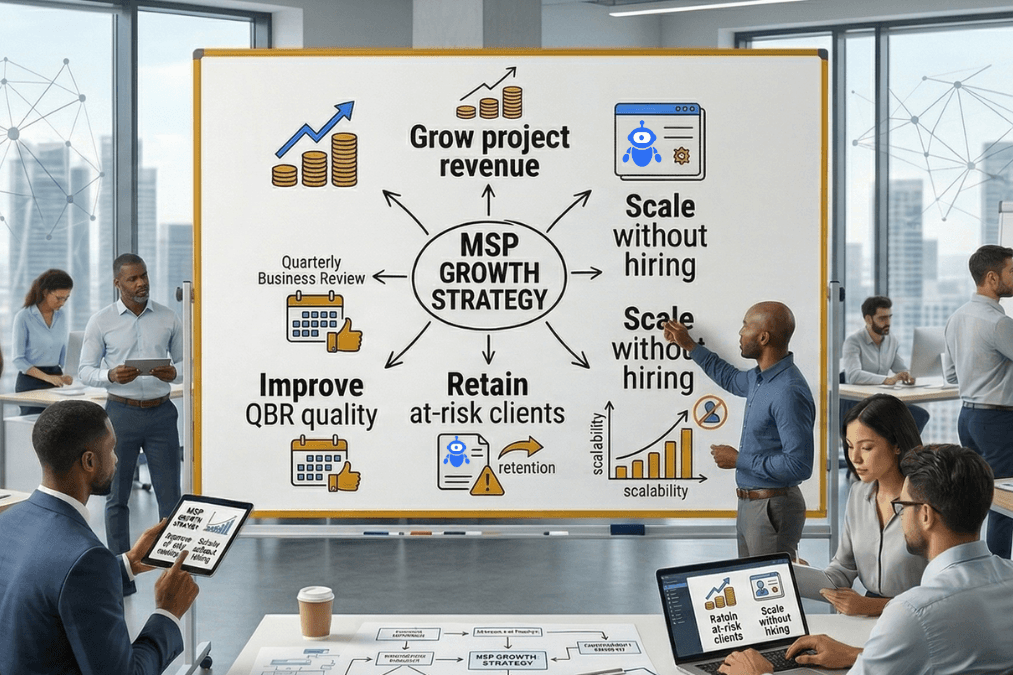
The MSP channel has never had more access to good strategic thinking. Peer groups, industry consultants, QBR frameworks, vCIO playbooks, benchmarking data — the intellectual infrastructure around how a managed service business should grow has never been richer.
And yet most MSPs we encounter are still stuck. Not because they lack a strategy. Because the distance between their strategy and their daily operation is filled with the wrong material: fragmented data, manual processes, tribal knowledge, and reactive workflows that consume every available hour before any growth-oriented work can begin.
The insight isn't missing. The execution layer is.
Strategy without execution intelligence isn't a plan — it's a hope. The MSPs who close the gap aren't working harder. They're working with better signal. |
Strategy Lives in the Room. Execution Lives in the Data.
Picture a well-run QBR roadmap session. A business owner and their leadership team spend half a day articulating priorities: expand into security services, improve project close rates, increase client retention, and grow average MRR per account. The conversation is sharp. The goals are clear. Everyone leaves aligned.
Three months later, the service desk is still reactive, the project pipeline looks the same, and the next QBR prep will take just as long as the last one. Not because the strategy was wrong — because nothing in the operational environment changed to support it.
The tools that run the business captured none of the strategic intent. The PSA is still tracking tickets. The RMM is still monitoring endpoints. SharePoint still holds documentation that no one has time to consult. The data that would connect strategic direction to operational action is scattered across systems that weren't designed to communicate with each other.
The Strategy | The Gap (Without MSP Business Intelligence) | The Execution |
Grow project revenue | No system surfaces which clients have unproposed opportunities this quarter | Opportunities flagged automatically per account |
Improve QBR quality | Prep still takes 5+ hours across 3 roles with an incomplete picture | Unified brief ready in minutes, full environment context |
Retain at-risk clients | Risk signals buried in ticket history, never correlated to account health | Risk flags surface before a client conversation goes cold |
Scale without hiring | Growth requires more headcount to manually process more data | Existing team acts on intelligence, not information assembly |
What MSP Business Intelligence Actually Does
MSP business intelligence isn't a dashboard. It's not another report your ops team has to build and your leadership team has to interpret. Done right, it's the connective layer that takes the operational data your stack is already generating and surfaces it as decisions your team can act on — without a manual translation step in the middle.
The distinction matters because most MSPs have tried the dashboard approach. They've built Power BI reports, ConnectWise views, custom exports from their RMM. The data is there. The insight still isn't — because pulling data together doesn't correlate it, and correlating it doesn't surface the right signal at the right time to the right person.
There is a difference between having data and having intelligence. Data tells you what happened. Intelligence tells you what to do next — and when. |
True MSP business intelligence connects your PSA ticket history to your RMM asset data to your client communication context to your financial performance — and identifies, automatically, where the revenue opportunity is, which clients are approaching a strategic inflection point, and what your account team should be walking into a conversation ready to discuss.
That's the execution bridge. It's what makes strategy actionable rather than aspirational.
SKAIA Is the Layer Between Strategy and Execution
Correlatio built SKAIA specifically for this gap — not as another tool your team has to operate, but as the AI Revenue Growth Companion that sits across your existing stack and does the correlation work that your people currently do manually, inconsistently, and at a cost to both their time and their strategic attention.
When SKAIA is running, your vCIO walks into a QBR with a complete picture of the client environment — hardware aging, licensing gaps, ticket patterns, open project threads — without a 5.5-hour data chase beforehand. Your account manager sees which clients have uncaptured project opportunities before the quarter ends. Your business owner has a clear line between what's happening in the client base and what it means for revenue.
The strategy doesn't change. The execution finally catches up to it.
If your growth strategy is sound but the execution keeps falling short, the problem isn't the plan. Book a 30-minute demo at Correlatio.io or reach us at Ready.ai@correlatio.io and we'll show you what the execution layer looks like.